ARTICLES
www.artindia.net
does not take any responsibility whatsoever
with regard to articles/ reviews/ previews /information published here.
Any suggestions/ comments /complaints etc. may be sent directly to the
writers/ contributors directly. We invite
you to contribute articles/ reviews etc. to ArtScape. You may sent in
your stories to art.india@yahoo.com along with scanned pictures.
 GS
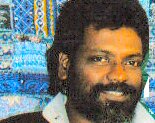
RAJAN is a music composer, classical flautist and an arts administrartor.
A product of Rukmini Devi Arundale's Kalakshetra, he is a disciple of
MD Ramanathan in vocal music and H Ramachandra Shastri in Flute.
GS
RAJAN is a music composer, classical flautist and an arts administrartor.
A product of Rukmini Devi Arundale's Kalakshetra, he is a disciple of
MD Ramanathan in vocal music and H Ramachandra Shastri in Flute.
A former Deputy Secretary of the National Academy of Music, Dance and Drama (SNA) of the Government of India, Rajan continues to be the festival director of many International festivals.
by GS RAJAN
Years after the death of MD Ramanathan, fondly known as MDR, there is still no musician able to live up to the grandeur and grace that characterized the life and music of this eminent Carnatic vocalist. Even the bass voice and distinctive musical style, specializing in the slow tempo, have not been bestowed on anyone else. MDR's rendering of the sahitya (lyrics) of a kriti was always with a view towards preserving the meaning.
He would never take a pause or go into an elaborate sangati (musical variation) at an inappropriate syllable. This habit is so common that it goes unnoticed among many Carnatic vocalists. Since the compositions of the great vaggeyakaras are in Telugu, Sanskrit, Kannada, Tamil and Malayalam, only a very careful singer or one versed in all these languages, can avoid unintentionally distorting the meaning. Sometimes a single breath or an elongation of the syllable 'a' taken at the wrong time can bring about ludicrous changes in the spiritual meaning of the text.
However, a strong criticism made of his treatment of the lyrics was that he would add words, extempore. For example, in a Tyagaraja kriti if the word to be sung was Rama, he would prefix Sri or Ananda to the name. This was felt to be taking liberties with the composers, whose literary gifts were undoubtedly above editing. The quality of voice is of course Nature's gift, but some musicologists consider it a failing that MDR who taught for decades could not produce a single disciple in the likeness of himself. But those who have had the opportunity of seeing him and hearing his recitals would agree that MDR's music was not a baani or mould, but rather a totally distinctive personal expression, and it would have been impossible for such a learned musician to encourage clones devoid of the essential spirit. MDR's emphasis on the slow kaala pramaanam (tempo) gave his renditions profundity. Raga bhava, laya, the meaning of the song, all fused into one seamless, uplifting experience. Mathematics was not the challenge here. There was no scope for wizardry either in melody or percussion accompaniment. The challenge lay in maintaining the tempo and evoking the quiet rhythms of inner thought, rediscovering the essence of each raga, and its relationship with a kriti. Listening to his concerts brought on a feeling of peace. If one understood the sahitya of the compositions, the Puranas from which they were drawn stood vividly before the eyes, and the effect was akin to having participated in a religious ceremony.
All these qualities MDR was able to bring out in his music seemingly without any conscious effort. His was music for the soul. Technically, MDR inherited the musical parampara of the saint composer Tyagaraja. MDR's guru Tiger Varadachariar was a disciple of Pattanam Subrahmanya Iyer, who was a direct disciple of Tyagaraja. MDR's devotion to his guru was a celebrated example of the best in Indian tradition. As a young physics graduate in 1944, MD Ramanathan came to Madras from Kerala and joined Rukmini Devi's Kalakshetra, where the legendary Tiger Varadachariar was part of the galaxy of eminent artists she had invited to her institution. Both Rukmini Devi and his guru loved him like a son and recognized his immense artistic capabilities. With their blessings, MDR's arangetram (debut) was organized in 1949. Venkatarama Shastri presided over the occasion. MDR spent the rest of his life at Kalakshetra, helping it to grow over the years and adding stature to its reputation.
In his later years he was the Principal, and the post acquired dignity thanks to his personal qualities and his inner light. The fact that he was learned took nothing away from MDR's capacity to make people laugh. His nature was welcoming and never intimidating. As a teacher he had certain strict policies, such as never allowing his students to take written notes in class. This was of course in the ancient tradition of the classical arts, which must be absorbed into the disciple's experience and cannot be bound in a notebook. But if this seemed difficult, his entertaining way of teaching ensured that the student had plenty of tricks to remember the lesson by. Sometimes he would sing the musical phrases in such a way as to give them a meaning in Tamil. 'Ni dha pa ma' became 'nee thappammaa' ('You are wrong my dear'), and 'ga ma, ga pa, ga ni' with an innocuous nasal prefix (unga amma, unga appa, unga anni) turned out to be a list of relatives. Rather than giving his students a charted course to follow, he taught them to observe and perform sadhana and equipped them with the means to find their own path. Surely this is the greatest gift a guru can bestow.
On the flip side, however, MDR's refraining from giving his students a definite course, and the fact that he never presented anyone publicly as his disciple, led to a sort of vagueness after his death, which could be taken advantage of. Today many musicians claim to be his disciples and it would be extremely difficult to challenge them. MDR did receive national recognition such as the Sangeet Natak Akademi Award, the Padmashri and the Kerala Sangeetha Nataka Academy Award, but being essentially innocent of the cut throat ways of competitive artists, and content to be a devout gentleman, he did not become a jet setting globe trotter whom it should have been India's pride to present before the world. The Music Academy hid inside its regional strait jacket when the suggestion to honour MDR with the Sangeeta Kalanidhi award was rejected on the grounds that it should not be given to a musician from Kerala that year. (This about a man who made Chennai his home and graced its music scene for forty years.) The loss of course was entirely the Academy's, but the distorted logic rankles. Chennai is considered the Mecca of Carnatic musicians, but if its apex institutions are free to adopt such blatantly biased attitudes, sad is the cause of our music with its spiritual heritage. MDR died the following year and the Music Academy lost its chance to honour the most luminous star in its firmament. Today real rasikas of Carnatic music evoke his grandeur through the few available commercial recordings and AIR archives, nostalgically reliving some inspired moments of an inspired soul.
© Art India Net. ® 1998--2007. We welcome your suggestions and comments to improve this site. Please post an e-mail to add information.
Founder/ Content Editor/ Site Construction/ Maintenance: GS Rajan, Technical Advisor: Sudhir Gandotra Hosted by Communicators - Indserve Infotech P Ltd. © ®